Open Badges don’t work as expected!
Introduction
At this stage of the project we explored how to use and possibly adapt existing Open Badge tools to create the instruments supporting the development of Local Recognition Networks (LRNs).
It is when we realised that, while being very efficient in certain contexts, existing Open Badge tools might not be aligned with REVEAL’s objectives. The contexts where current badge tools are most effective is where the audience is captive, which is the case for formal and non-formal education and training which are the main contributors to, and beneficiaries of, the adoption of Open Badges.
In a formal context:
- The organisation buys a subscription to a badge platform
- Educators and trainers can be trained to use the platform to:
- Design badges
- Assess badges
- Issue badges
- Students and trainees can be trained to:
- Create and configure an account on an Open Badge Backpack/Passport
- Create a profile
- Import badges
- Publish badges
- Endorse badges
- Share badges on social media
How accessible is this technology to people with low literacy, disenfranchised and, more generally, misrecognised? “Pure” Open Badge systems, i.e. applications dedicated to creating and displaying badges, are meaningless unless integrated into an initiative which is not about Open Badges but where badges are one of the byproducts of that initiative—community projects, social integration, employment, education, etc. The design and implementation of such an initiative needs to be mediated or scaffolded. Cities of Learning[1] is a good example of how Open Badges can be integrated into an initiative that is bigger than Open Badges—the mediation was provided by Badgecraft which designed the application. “La Normandie Badge les Compétences” is another example—the mediation was provided by the region and actors on the territory.
An example of mediation/scaffolding closer to REVEAL’s target audience is K-DABRA, an association led by “people with distance to employment“ in an economically deprived area using Open Badges to recognise each other’s knowledge, experiences, competences, etc. In that case, after the initial impulse provided by La Ligue de l’Enseignement[2], the members of the K-DABRA community (“La Coopérative des Savoirs” / The Knowledge Cooperative) rapidly worked in complete autonomy. No need for scaffolding anymore.
How can we ensure that, when working with “people with distance to employment“ the mediation does not distort the voice of the audience nor the scaffold enclose it?
One possible way for mediation is the co-creation of badges. But the limit of such an exercise is the availability of mediators and their competences. Without mediators, no mediation therefore no recognition. And with mediators, how to ensure that “co-creation” of badges will not result in the creation of “ventriloquist badges.”
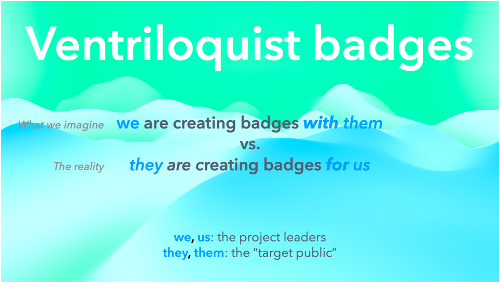
Possible reason for “ventriloquist badges” is the source of funding: if there is a source of funding for “soft-skills” it is very likely that the result will be the creation of “soft-skills badges” that might ignore the recognition (hence no badge) of the practices where those skills were activated. The fact that the participants have “co-constructed” those badges demonstrates that they are conformant to the requirements of the initiative, rather than empowered.
To understand how REVEAL’s main target audience could be empowered to create their own Local Recognition Networks (LRNs) using Open Badges to recognise and be recognised we needed to move our reflection away from the operation of Open Badges in the formal and non-formal contexts and focus on the informal context and how informal recognition operates.
About formal, non-formal and informal recognition
The current generation of Open Badge technologies mainly contributed to moving the centre of gravity of recognition from the formal to the non-formal learning sector (c.f. box below). Questions like “will badges replace diplomas,” although ill-formulated[3] are testimonies to that shift. Now associations, clubs, continuing and adult education providers, public authorities as well as small and large businesses use Open Badges to make visible globally the recognitions they issue locally. While non-formal recognition[4] existed long before Open Badges were invented, Open Badges contributed to making it more visible— as well as verifiable and actionable.
If Open Badges have primarily benefited non-formal recognition, what about informal recognition? Has informal recognition also profited? If so, how? To provide an answer to those questions we need to provide a definition of informal and non-formal recognition.
| ● Formal learning is always organised and structured, and has learning objectives. From the learner’s standpoint, it is always intentional: i.e. the learner’s explicit objective is to gain knowledge, skills and/or competences. ● Non-formal learning is generally organised and can have learning objectives. It may occur at the initiative of the individual but also happens as a by-product of more organised activities, whether or not the activities themselves have learning objectives. In some countries, the entire sector of adult learning falls under non- formal learning; in others, most adult learning is formal. ● Informal learning is not organised, has no set objectives in terms of learning outcomes and is not intentional from the learner’s standpoint. Often it is referred to as learning by experience or just as experience. source: OECD, Recognition of Non-formal and Informal Learning |
A first attempt for defining informal and non-formal recognition is to start from the definition of informal and non-formal learning and state:
Informal recognition is to formal recognition what informal learning is to formal learning. Just as informal learning is not an inferior form of learning, informal recognition is not an inferior form of recognition.
Conversely
While we have developed processes to recognise the value of informal learning[5], what have we done to recognise the value of informal recognition?
One should not forget that what is formal today is often the result of something that was informal before being formalised. Without informal learning (e.g. research) and recognition (debates, peer review, trust), there would be no science!
Modelling on the OECD definition of informal and non-formal learning (c.f. box above), we could define formal, non-formal and informal recognition as:
- Formal Recognition is typically structured and overseen by an accredited authority responsible for issuing formal diplomas or certificates. It is firmly anchored in established structures, such as official curricula, pre-designed learning outcomes, and competency frameworks. It is the kind of recognition typical of initial formal education (school, university) or professional bodies where there’s a clear, predefined path to earning a credential.
- Non-formal Recognition takes place within structured communities outside the realm of traditional educational establishments: associations, adult and continuing education bodies, small and large businesses, local councils. It may refer to formalised standards, whether specific to a sector, a profession or an organisation.
- Informal Recognition is the most flexible and spontaneous form of recognition. Not formally structured, informal recognition emerges organically as a result of the actions of the members of a community. The recognition can stem from an individual’s own claim of an achievement, a new competence or aspiration, and endorsement from peers and community members.
| While it is the context where a recognition is produced that defines whether it is informal, non-formal or formal, those contexts may have the power to transform informal recognition into non-formal recognition and non-formal recognition into formal recognition: There is a continuum between those different forms of recognition and different contexts: ● A university has the power to transform informal and non-formal recognition (testimonies, reports of experience, portfolio, artefacts, etc.) into a formal recognition (diploma, certificate, etc.). This transformation process is called Prior Learning Assessment and Recognition, or Recognition of Prior Learning (PLAR/RPL[1]), ● An association or enterprise has the power to transform informal recognition into non-formal recognition (certificate, recommendation letter, etc.). For example, employees could design their own badges to claim the mastery of certain skills and the management could either directly issue or endorse those badges. It is important to understand that endorsing a badge means: “If I was in a position to issue that badge to you, I would gladly do it.” Of course, endorsements come from a range of people and most wouldn’t be allowed to issue the badge they endorse: the patient who endorses the badge of a doctor wouldn’t have the authority required to issue such a badge, while another doctor might. When introducing the notion of community of practice (CoP) then the endorsements from the other members of the CoP can be clearly differentiated from those from the outside and the meaning is very close to “as a member of the CoP, I validate your claim” which is another way to state “If I was in a position to issue that badge to you, I would do it.” [1] PLAR (Prior Learning Assessment and Recognition) defines processes that allow individuals to identify, document, have assessed and gain recognition for their prior learning. The learning may be formal, informal (experiential) or non-formal. RPL is a more comprehensive term that also includes academic credit transfer. |
It is important to note that formal/non-formal/informal recognition spaces do not always map directly to formal/non-formal/informal learning spaces. Also, recognition spaces are not independent but overlap: while attending a school (formal education) will eventually lead to the delivery of formal recognition (certificates, diplomas) it is simultaneously the space where informal recognition, and misrecognition, takes place.
| Recognition | |||
| Formal | Non-formal | Informal | |
| Issuers | Limited (authorities) | unlimited | unlimited |
| Quantity | Limited (diplomas) | unlimited | unlimited |
| Agility | It can take up to 10 years between the identification & formalisation of a new diploma and the celebration of the first graduations | Recognition “as you go” | Recognition “as you go” |
Formal, non-formal and informal recognition
Informal learning and recognition is not a landfill where everything that is neither formal or non-formal can be disposed of, but rather the cradle of all learning and recognition, including formal. It is the reason why we need to pay greater attention to the informal, understanding how to support and nurture it while becoming aware of the risks of possible deleterious effects of over-formalisation.
Open Badges: who do they really empower?
As described in the previous article, while Open Badges were invented to make informal learning visible, what Open Badges revealed is the asymmetrical nature of the current recognition ecosystem.
To prove their credentials, individuals need badges, institutions need accreditations:
- Individuals need a “backpack” or a wallet to store their credentials
- institutions don’t need a “backpack” or a wallet to store their accreditations
- Not all Open Badge systems allow individuals to issue badges and when they do the functionalities can be severely restricted
- Current “backpacks” and wallets only display the badges received, not the badges and endorsements issued by an individual.
Of course, since 2011, when Open Badges were invented, things have evolved. But traces of this not so distant past are still vivid in most Open Badge environments. By not offering individuals the possibility to create and issue Open Badges, the implicit message was: individuals have no say in the recognition ecosystem. Of course, it was not formally “forbidden” for individuals to issue badges, it was sufficient for the early tool developed by Mozilla, the Backpack, to block that option.
Another aspect of the asymmetry becomes apparent when some systems allow individuals to issue badges: badges issued cannot generally be made visible in the space of the issuer (remember, issuers were not required to have a backpack!). Of course, there is a privacy issue, but it wouldn’t be difficult to ask the recipients whether they accept or not to make their badges visible in the space where they have been issued. After all, with the 2.0 specification, the issuer has to keep the original version badge in order to verify the authenticity of the copies. Yet, wouldn’t it be great if someone could show how many recognitions (badges) have been offered and accepted.
By keeping issued badges (and endorsements) hidden, one reinforces the notion that people are primarily recognition collectors, anecdotally recognition issuers.
While individuals were still assigned a minor role in the emerging recognition ecosystem, associations, organisations and communities understood the value of Open Badges. The actors of non-formal education now had an instrument they could use to be more visible, directly and indirectly through the recipients of their badges. Institutions of formal education had diplomas and certificates, actors of the non-formal space now had Open Badges.
What the first generation of Open Badge technologies actually achieved is the empowerment of the actors of the non-formal space. Open Badges moved the centre of gravity of recognition power from institutions of formal education to the non-formal sector.
While individuals have indirectly benefited from the shift in recognition power, their own empowerment remains to be achieved. The empowerment of individuals as active conscious participants in an open recognition ecosystem is necessary to transform the recognition practices and “open-up recognition.” Otherwise, the risk is that formal recognition methods and practices will be slavishly mimicked in informal and non-formal spaces. There are many “good” reasons for that: accountability[7], competing with the formal sector, old habits, lack of imagination…
Exploring the limits of Open Badges platforms
If we accept the premises “we all have the power to recognise” and “Open Badges are designed to make recognition visible” we must acknowledge that the Open Badge technology developed so far is good at making non-formal recognition visible[8] and poor at supporting informal recognition. And if Open Badges systems are not good at supporting informal recognition, then how is it possible to create a continuum between informal, non-formal and informal recognition? Is the problem with Open Badges themselves or with the technologies used to produce and exploit them?
Why are Open Badges poor at supporting informal recognition? One possible reason is that developing technology and providing hosting services generate costs, therefore it makes sense that applications and services are designed to satisfy creditworthy clients. Another possible reason, probably deeper, is the mindset: the developers of the Mozilla Backpack could have easily added the few lines of code required to issue badges. Conversely, they could have made the Backpack an integral part of the tools developed to issue Open Badges. What rationale lies behind those design decisions if not the habitus[9] developed through formal education?
The vocabulary itself, “criteria”, “evidence”, “alignment” come from the world of formal recognition, certification and accreditation. The main value of a piece of evidence is for the assessor to judge whether or not to issue a badge. Exchange the word evidence for documentation, then it’s a whole new realm of potential applications, like documenting practices for the benefits of the other members of a community.
Informal recognition is actually a common practice and is probably one of the main fuels powering social software engines: without the likes, retweets and comments, social software would lose most of its value. Could it still be classified as “social software”? Reclaiming control of digital forms of informal recognition from Google, Facebook (Meta) Linkedin and Twitter might be a path to break those monopolies.
So, on the one hand, we have social platforms that have privatised informal recognition, on the other Open Badge platforms that have slavishly mimicked formal recognition mechanisms and vocabulary, excluding, or at best marginalising, informal recognition. Imagine an email application where you could receive only emails from “recognised authorities” and wouldn’t be allowed to send emails, unless you bought a subscription to a service that is often so counterintuitive that it would take more than a full day training before understanding how to use it—finally to decide that it’s not for you.
So, if we place ourselves in the perspective of a continuum between informal, non-formal and formal recognition, the current Open Badge technology only covers the gap between non-formal and formal, not between informal and non-formal. Open Badges were initially designed to make informal learning visible, and the path for achieving that goal was to equip the (creditworthy) actors of the non-formal sector (adult education, clubs, associations, etc.) with badging systems. Current Open Badge technology has been primarily formatted to serve the needs of those organisations, not individuals.
To be recognised as worthy credential issuers, the non-formal sector has been desperately trying to make badges as good as “real” credentials—read “diplomas.” Further, so as not to offend the providers of “real” credentials, many agreed to christen this new object “micro-credential” — “mini-credential” might have been too daring a term for the egos of the holders of ‘real’ credentials.
Going back to the goals of REVEAL, which is to create a continuum between informal, non-formal and formal recognition, we had to acknowledge that current badge technology covered the informal to formal recognition path, while not properly supporting the informal to non-formal recognition path. To support the move from informal to non-formal recognition, we needed first to provide support to informal recognition, something that current Open Badge technology has very limited provision for without proper mediation or scaffolding.
From there, the project’s direction depended on our understanding of the problem. Was it:
- Intrinsic to Open Badges?
- Contingent to the current state of development of the recognition technology?
- Both?
Based on our understanding of the problem, what kind of solution or trade-off could we implement:
- Adapt an existing badge application to be more “informal recognition friendly”—by developing an extension using the API[10] of a badge system, develop a plug-in?
- Create (a proof of concept[11] of) a new “informal recognition application” that would facilitate the transition to non-formal recognition and Open Badges?
Next article: Before the Open Badge was… the word!
[1] https://www.citiesoflearning.net/
[2] A secular movement for popular education, the Ligue de l’enseignement offers educational, cultural, sporting and leisure activities. Through 102 departmental federations, it brings together 20,000 local associations in 24,000 communes, representing over 1 million members.
[3] Open Badges are just “containers” that can contain any type of recognition, whether formal, non-formal or informal, whether a high stake diploma or the participation in an event. A well formulated question could be: will digital credentials replace paper credentials?
[4] Non-formal recognition manifests in many ways: hiring, promotion, new assignments, recommendations, pay rises, perks, community awards, etc.
[5] VAE (Validation des Acquis de l’Expérience), RPL (Precognition of Prior Learning), PLAR, etc.
[6] PLAR (Prior Learning Assessment and Recognition) defines processes that allow individuals to identify, document, have assessed and gain recognition for their prior learning. The learning may be formal, informal (experiential) or non-formal. RPL is a more comprehensive term that also includes academic credit transfer.
[7] while indicators can be valuable tools for assessing performance, an overemphasis on them at the expense of the broader mission can create a multitude of risks: distort priorities, encourage undesirable behaviour,
[8] formal recognition as well, but it is already visible through certificates and diplomas. The problem of “visibility” is primarily for informal recognition.
[9] In the sense of embodied dispositions or tendencies that organise how people perceive and respond to the world around them.
[10] Application Programming Interface
[11] The budget of an Erasmus+ project is not sufficient to create more than a prototype or PoC.