#Openbadges + #Blockchains = #BitofTrust ?

One aspect of the question regarding a possible relationship between blockchains and Open Badges is to wonder whether the blockchain should be treated as some kind of add-on to the existing Open Badge structure/standard, or should Open Badges be integrated within a blockchain?

A starting point for an informed answer to this question is to do a simple test: take an Open Badge generated by one issuing platform and try to import it into another issuing/hosting platform. I have done this experiment recently, taking only a very small sample, and the results were rather… (un)conclusive — BTW, one suggestion for the Standards Working group would be to run a real life interoperability test (not just through a formal proof) across all platforms and publish the results.

Interoperability is a classical problem to which the ePortfolio community was confronted some years ago and to which no convincing answer was ever provided — the IMS-Global ePortfolio and Leap2A specifications (2 specifications for interoperability is already one too many!!!) are only used by a handful of ePortfolio platforms — notwithstanding that there are many ePortfolios that do not use any ePortfolio platform at all! Moreover, when we organised plugfests during previous ePIC conferences, we had to admit that 3 platforms using the same technical specification (IMS ePortfolio at the time) had problems understanding each other: exporting one ePortfolio from one platform then importing it to another did not always work properly…

One could have imagined that with a structure much simpler than ePortfolios, the problem of interoperability would have disappeared. It has not. And now that we have allowed extensions to the specification, the order of magnitude for potential interoperability problems has increased geometrically, not just arithmetically. Yet, the possibility to extend the specification, even by one single issuing platform, willing to gain a competitive advantage, with a better or innovative service, should probably be allowed. We certainly do not want a “one-size-fits-all” issuing platform. Innovation must go on!

Are blockchains the solution to Open Badges interoperability?

Continue reading

#blockchains vs #OpenBadges (“blocks without chains”)

Last Thursday, as I attended a meeting at the old Paris stock exchange (palais Brogniard) with people working on blockchains to discuss the Open Badge Passport, what did I discover? A number of the ideas we wanted to develop with the Open Badge Passport (as services exploiting the content of badges metadata) were already in full development using… blockchains, not Open Badges. That was some reality check! The following morning I read Certificates, Reputation, and the Blockchain (link) where Philipp Schmidt, from the MIT Media Lab, explains how they are moving from paper certificates to blockchains after a short encounter with digital badges…

Issuing a certificate is relatively simple: we create a digital file that contains some basic information such as the name of the recipient, the name of the issuer (MIT Media Lab), an issue date, etc. We then sign the contents of the certificate using a private key to which only the Media Lab has access, and append that signature to the certificate itself. Next we create a hash, which is a short string that can be used to verify that nobody has tampered with the content of the certificate. And finally we use our private key again to create a record on the Bitcoin blockchain that states we issued a certain certificate to a certain person on a certain date. Our system makes it possible to verify who a certificate was issued to, by whom, and validate the content of the certificate itself.

Suddenly Open Badges seemed to have regressed from a technology that could conquer the world to a parochial technology solely at the service of the great priests of education spraying badges like papal indulgences so their parishioners could join the heaven of employment… one day… if their prayed with enough fervour. Continue reading

Expressing distrust within the #OpenBadges Ecosystem

Recently, I have been confronted with a rather unnerving situation where the sense of ethics of certain entities (could be people and/or organisations) was, to say the least, questionable. As I wondered how to react to this situation and how to convey my lack of trust in within the Open Badge Ecosystem, the idea of a Badge of Distrust came to mind.

As my take on badges is that they are trust statements (I’m working on refining that definition, but that will do for the time being), I realised that issuing distrust badges would put me at odds with my position where trust is understood as a positive value, as in I trust this person’s integrity. In my frame of reference, the utterance I trust that this person is a thief has a very different meaning coming from a gang leader looking at a prospective associate or from a law abiding citizen reporting a crime. For the gang leader it means “he/she is one of us” while for the law abiding citizen it means “he/she is one of them” — things can become quite convoluted when a thief steals from another thief…!

As one of the basic rules of the Open Badge Infrastructure is the recipient has the option to reject the badges they do not wish to collect, we could imagine a perfectly secure digital world where a thief would be very happy to collect a “master thief” badge from a gang leader as it could be beneficial to his/her idiosyncratic employability — crooks know how grow their own trust networks and prisons are their Open University! On the other hand, if a similar badge was issued by a law abiding citizen, it is very unlikely that he/she will ever collect it. A Badge of Distrust is not something that people are likely to collect — although, if someone like Tony Blair offered me such a badge, I would be delighted to promote it at the top of My Values badges. I would consider being distrusted by such an individual a badge of honour!

From the previous example we can foresee that accepting Badges of Trust from friends and Badges of Distrust from foes is a powerful means towards building and nurturing trust networks of all kinds — a property that should be fully explored in the development of the Open Badge Passport. 

There remains the configuration of a Badge of Distrust sent to a foe. Why would a foe accept a badge of distrust? What would its value be if not collected? To explore that question further, we first need to reflect on why we would need to issue Badges of Distrust?

Why would we need Badges of Distrust?

Badge of ShameThe Open Badge Ecosystem is a conversational system, where things are not fixed once and for all. The value of credentials is not absolute, it varies across space and time, as well as with the position of the observer within the network. Looking at the dynamics of networks construction, their topology, how clusters are formed and relate to each other, will help us compute the level of confidence one might assume in making a decision based on the information provided by the network. Would the introduction of a distrust component, a Badge of Distrust (BoD), improve the quality of the decision making process? Are there potential risks associated with BoDs? Continue reading
#OpenBadges for Holographic Identities

What is the definition of identity? There is the self-identity as narrative (Giddens), the identity-through-others (Ronald D. Laing). For Gilbert Simondon it is the result of the process of individuation, while for Edgar Morin our identity is holographic:

Moreover, in human beings as in other living creatures, the whole is present within the parts; every cell of a multicellular organism contains the totality of its genetic patrimony, and society inasmuch as a whole, is present within every individual in his language, knowledge, obligations, and standards. Just as each singular point of a hologram contains the totality of information of that which it represents, each singular cell, each singular individual contains hologrammatically the whole of which part and which is at the same time part of him.
Edgar Morin, Seven complex lessons in education for the future.

So, our identity is not just what makes us unique or identifiable, it also comprises what connects us to all other human beings, living creatures and the whole universe. Our identities are singular points in a continuum of identities. The interweaving of our identities is what makes the social fabric. Our identities are the threads of the social fabric. Like the elementary particles of the universe that are both waves and particles, our identities are both singular points and threads, localised and distributed, sovereign and interwoven. Another characteristic of identities is their ability to keep their integrity while being metastable in a milieu where they grow (c.f. individuation). 

This leads to the issue of collective identities and their relationship with individual identities. For example, what defines us as citizens? Danny Wildemeersch and Joke Vandenabeele in Issues of citizenship: coming-into-presence and preserving the difference, elicit two approaches to the definition of citizenship: 

  • citizenship-as-outcome, where “democratic citizenship is regarded as a status that is only reached after one has completed a particular developmental and educational trajectory. This places the young person in the awkward position of not yet being a citizen’ (Biesta 2006).” (ibid.)
  • citizenship-as-practice, “young people learn just as much about democracy and citizenship from the democratic and undemocratic experiences encountered in their day-to-day lives as from the official citizenship curriculum […] If young people’s everyday lifeworld does not present opportunities for real participation, then it doesn’t make much sense to organise citizenship classes designed to transform young people into active responsible citizens’ (Biesta 2006).”

From these two definitions it is easy to imagine two very different approaches to using Open Badges: one would be the creation of a pathway at the end of which one could eventually gain a citizen badge, while the other could be the unconditional attribution of citizen badge that could be nurtured through endorsement, the connection to other people, initiatives, achievements, etc. One is about collection, the other, connection, one conditional, the other unconditional, one is static the other dynamic, one is standardised, the other inventive and creative, one is defined for the citizens, the other with and by them.

These two definitions also have consequences on the type of digital infrastructure we need. The first definition, citizenship-as-outcome, is fully compatible with addressing identity as a set of attributes, like a series of Open Badges collected in a silo. The second definition needs more than a safe to hoard collections of attributes, something more holographic where by looking at one citizen one could see a whole society and its democracy in action . 

How does this concept of holographic identities, localised and distributed translate into the digital world?

Limits of identity models in the digital world Continue reading

#OpenBadges – Micro-credentials: what can we learn from micro-credits?

“The best way to find out if you can trust somebody is to trust them.”
― Ernest Hemingway

Are micro-credentials a disruptive innovation, just as micro-credits (micro-loans) were thought to be a few years ago? To answer this question we should first find out what can be qualified as a disruptive innovation? According to Wikipedia:

A disruptive innovation is an innovation that helps create a new market and value network, and eventually disrupts an existing market and value network (over a few years or decades), displacing an earlier technology.

Open Badges are creating a new market, the market of Open Credentials (micro-credentials are just one type of Open Credentials) and establishing a new currency, or more precisely reinvigorating one of the oldest currencies ever: trust.

Trust has many properties. First, it’s free and when offered, it enriches both the giver and the recipient. And when the recipients of trust get richer (with trust), their increased wealth can trickle back to those who initiallyoffered their trust. While it might still need the philosophers’ stone (link) to be transmuted into gold, trust can nevertheless be transformed into real cash as one experiences when applying for a loan. Con artists and banks* also know how to make cash out of trust!

For the poorest, things are different. One of the few assets they cannot be totally deprived of is trust. Thanks to the Nobel Prize winning Grameen Bank (link) founded by Muhammad Yunus, they now have the power to convert trust into micro-loans.

Grameen Bank is owned by the borrowers and it is based on trust. It does not require any collateral from its borrowers. Since the bank does not wish to take any borrower to the court of law in case of non-repayment, it does not require the borrowers to sign any legal instrument.

Were micro-credits transformative?

What lessons could the Open Badge practitioners learn from the Grameen Bank and the many micro-credit organisations that have been spawned since its creation? Can we draw a parallel between micro-credits and micro-credentials in terms of empowerment and potential social transformation? Could Open Badges create the conditions for the emergence of a new economy?

Continue reading

OpenBadges: The Deleterious Effects of Mistaking Security for Trust

What is the relationship between trust and security, security and privacy, privacy and personal data protection? For some time now, I knew that there was something wrong with the so-called trust technologies, but I did not take the time to pin down what the source of the problem was. Apart from rechristening them as distrust technologies, I did not make the effort to explore any further the matter. Here are two excerpts from previous posts:

Is there an escape from an alternative that can only lead to an escalation in the development of distrust technologies? in Why Open Badges Could Kill the Desire to Learn?

One of the most interesting and undervalued features of the Open Badge Infrastructure is trust: I have commented before that there is a risk for the Open Badges’ pretty pictures to become what the proverbial tree is to the forest of trust. I’ve also written that OBI is a native trust infrastructure, while most of the so-called trust architectures would be better described as distrust architectures (in a native trust environment, trust is by default, while distrust is generated by experience; in a distrust environment distrust is by default while trust is generated by experience). in Punished by Open Badges?

Designing Principles for a (dis)Trusted Environment

What brought me to explore further the issue of trust and security was the participation at a workshop organised by the Aspen Institute at SXSWedu 2015. The participants were invited to produce a series of scenarios eliciting the design principles of a trusted [digital] environment. The workshop took place the day following a session on “Designing Principles for a Trusted Environment” during which the winners of the DML Trust Challenge were announced.

While the challenge we were invited to address was the design of a trusted environment what struck me in most of the proposed scenarios was that they did exactly the opposite: they designed an environment where distrust was the founding principle. The designing principles for a distrusted environment were:

If you have a problem with trust the solution is increased control and security measures.

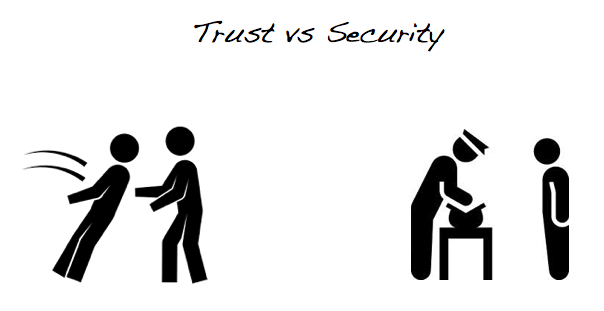
While this principle might sound fine to the superficial reader, the problem is that it reveals a misconception of what trust is about and, consequently, on how to deal with situations where low levels of trust are an issue. While both trust and security are related to safety, they are at the two ends of a spectrum.

While one can take security measures, send security forces, one cannot take trust measures and send trust forces. Security is something you can do to things, trust is something you can only get from within. Mistaking one for the other, trust for security, could (and generally does) have deleterious effects on trust.

Continue reading

#OpenBadges best friends to #ePortfolio practitioners best foes to ePortfolio platforms?

Kate Coleman’s (@kateycoleman) has opened a discussion on “ePortfolios and OpenBadges – friends or foes?” (link). Here is my attempted response to her question.

Open Badges best friends to ePortfolio practitioners and best foes to ePortfolio platforms? Let’s face it: the ePortfolio platforms of today are not that different from those that existed 10 years ago and many ePortfolios do not use any dedicated ePortfolio platform. If ePortfolio platforms want to keep up with innovation they will have to do much better than adding a layer of Open Badges; they might want to reinvent themselves from Open Badges.

Open Badges will facilitate the building of rich, trustworthy ePortfolios. We will be able to create truly “open ePortfolios” — one should note that there is a significant difference between using an “open source” eportfolio system and creating “open eportfolios.” With Open Badges, ePortfolios won’t be simply “open” they will also be “distributed” and “shared” and it is these qualities that will contribute to making them “trustworthy.”

Eventually we could describe the difference between Open Badges and ePortfolios as the difference between identity as self-narrative (ePortfolios) and identity through others (Open Badges).

In a presentation I gave in 2009 on “ePortfolio, the engine for learning communities” I presented ePortfolios as “the threads of the social fabric constructing our identity.”

Due to the siloed nature of current ePortfolios, this didn’t happen. With Open Badges, things are slightly different: no more silos and many threads, the threads of Open Badges feeding our interwoven networks of trust.

If I had to revise the 2009 presentation, it would be:

Open Badges: the substance from which are made the threads of the social fabric constructing our identities

#JeSuisCharlie #OpenBadges

JeSuisCharlieI have lost friends whose irreverent cartoons contributed to forging my character and political views. Cabu and Wolinski were among the heros of my teenage years. Nothing was sacred to them, nothing but life! Their murder, the murder of an entire editorial board by bigots acting on behalf of a criminal organisation has transformed some of my  favourite cartoonists and economist (Bernard Maris) into another kind of heros: heros of democracy and free speech.

#JeSuisCharlie has been a tremendous response to those murders (17, including police force and simple citizens). My contribution to this movement is the creation of a different kind of Open Badge to state one’s commitment to democracy and free speech.

Je suis Charlie can be claimed using the link below:

https://openbadgefactory.com/c/earnablebadge/NHXANHmLPMmF/apply

#OpenBadges for Key Competencies

This post is an extract of a position paper, Key Competency Badges, a reflection based on the work done in the TRANSIt project in relation to the acquisition of key competencies.

How to combine Open Badges with key competencies? To what result? One way to approach this question is to recognise that key competencies are just one particular group of competencies, so what is good for the recognition of competencies in general, is likely to be just as good for key competencies. As there are already plenty of Open Badges used to recognise a large range of competencies, then it is just a matter of extending current practice.

What is implied with this approach is that Key Competency Open Badges will need key competency standards similar to the UK key skill 2000 introduced above. While it might seem unproblematic to define standards related to the mastery of mathematics and foreign languages, things might get more complicated with digital competencies and even more with the sense of initiative and entrepreneurship and social and civic competencies. For example, the French authorities decided to remove ‘entrepreneurship’ from the European key competency labelled “sense of initiative and entrepreneurship.” The French version is “autonomie et initiative” [5] (autonomy and initiative).

Continue reading

From ePortfolio to Open Badges – on the Individuation of Technical Objects

Introduction

In 2004, during the second international ePortfolio conference (La Rochelle, France) a group of participants agreed to launch a campaign on the theme ePortfolio for all! Their objective was “by 2010, every citizen will have an ePortfolio!” 10 years later, despite a growing number of ePortfolio initiatives worldwide, we are still very far from achieving this goal.

This text is an attempt at exploring why the global adoption of Open Badges is likely to succeed and how it might feedback into ePortfolio technologies and practices. For that purpose, in the perspective of the genesis of technological objects, I draw a parallel with the evolution of computer technology from the early generation of computers to the advent of integrated circuits and computer chips (CPU, central processing units). The emergence of Open Badges will be analysed as a result of the evolution of ePortfolios, their concrétisation (reification). ePortfolios are more abstract, Open badges more concrete as the result of an individuation process.

While the genesis of technological objects and the process of individuation has been described with talent by philosophers like Gilbert Simondon and Bernard Stiegler, this post simply aims at inviting the members of the ePortfolio community to reflect on their practices and the possible futures for ePortfolio technologies.

On the Mode of Existence of Technical Objects

In Du mode d’existence des objets techniques (On the Mode of Existence of Technical Objects, 1958) Gilbert Simondon describes the concrétisation of technical objects as the ability of objects to become more autonomous, self-regulated, in relation to the associated milieu in which they operate. This process has a corollary, abstraction, which is when an object becomes more dependent on its associated milieu, as is the case with a number of genetically modified organisms — e.g. induced sterility in order to control the crop market, regulations, etc.

Continue reading