#OpenBadges for Key Competencies

This post is an extract of a position paper, Key Competency Badges, a reflection based on the work done in the TRANSIt project in relation to the acquisition of key competencies.

How to combine Open Badges with key competencies? To what result? One way to approach this question is to recognise that key competencies are just one particular group of competencies, so what is good for the recognition of competencies in general, is likely to be just as good for key competencies. As there are already plenty of Open Badges used to recognise a large range of competencies, then it is just a matter of extending current practice.

What is implied with this approach is that Key Competency Open Badges will need key competency standards similar to the UK key skill 2000 introduced above. While it might seem unproblematic to define standards related to the mastery of mathematics and foreign languages, things might get more complicated with digital competencies and even more with the sense of initiative and entrepreneurship and social and civic competencies. For example, the French authorities decided to remove ‘entrepreneurship’ from the European key competency labelled “sense of initiative and entrepreneurship.” The French version is “autonomie et initiative” [5] (autonomy and initiative).

Continue reading

ePortfolios & Open Badges Maturity Matrix

July 2nd saw the first public presentation of  the ePortfolios & Open Badges Maturity Matrix, one of the outcomes of the Europortfolio initiative (www.europortfolio.org). This post reports some of the ideas that were presented during this webinar.

Why a Maturity Matrix?

A growing number of individuals and organisations are exploiting or planning to explore the benefits of ePortfolios and, more recently, Open Badges. What are the successful indicators of such an implementation? How does one implementation compare to another? What possible steps can be taken in order to improve current practices and technology?

While a number of reference documents have been published, in particular the very comprehensive guidelines from  JISC and the Australian ePortfolio Initiative, notwithstanding previous attempts at creating an ePortfolio maturity matrix, there is not yet a consensus, within the learning professional community, on what could constitute a maturity model of ePortfolios and Open Badges implementation.

The maturity model underpinning the ePortfolios & Open Badges Maturity Matrix aims at being inclusive, i.e. recognising what people and organisations are doing today, while providing a framework for future improvement, so that learning practitioners will be able to state: “this is where we are today, that is where we want to be next year.” The main function of the Maturity Matrix is to provide a tool to facilitate the dialogue with practitioners, leaders in education and decision makers. If you are an innovator and feel lonely in your institution, you can use the Matrix to engage in a dialogue with your colleagues, learning community and community of practice. If you are an education manager, you can use the Matrix to review and/or plan the changes required to support effective ePortfolio and Open Badge practice.

Continue reading

What have I learned from Moodle and Mahara?

I am currently working on a project (http://www.transit-project.eu/) the objective of which is to help secondary education teachers in developing the competencies they need to support the acquisition of key competencies of their pupils as defined by the Key Competences for Lifelong Learning Framework published by the European Commission. The course we are developing will be adapted to the different national contexts of the project partners.

The Key Competences framework comprises 8 key competencies:

  • Communication in the mother tongue
  • Communication in foreign languages
  • Mathematical, science and technology competencies
  • Digital competency
  • Learning to learn
  • Social and civic competencies
  • Sense of initiative and entrepreneurship
  • Cultural awareness and expression

I will detail in another post my criticism of this framework (which is like the wedding of the carp and the rabbit) but for now I will simply indicate that there is a much better and more properly structured framework developed by the Scottish government. It is called Curriculum for Excellence.

The Four Capacities —  the Scottish Curriculum for Excellence

The most obvious difference between the European and Scottish frameworks is the implicit vision of the individual: one is fragmented, the other holistic. The European Framework lists a set of skills, a kind of micro-curriculum organised in a series of subjects/disciplines — most of them are already taught in the current curricula. It is also extremely tame: one of the goal is not to create entrepreneurs, but simply to have a “sense of initiative and entrepreneurship!” While the European framework seems to be oblivious to the identity construction process, the Scottish framework clearly states that its goal is to produce successful learners, confident individuals, responsible citizens and effective contributors. The skills are a means to achieving that high level goal, which means that teachers and communities are encouraged to develop their own curriculum (examples). The European Framework lists a minimal set of skills for the learners, the Curriculum for Excellence sets a global context for the reinvention and the co-creation of many curricula with all the members of learning community.

Continue reading

Open Badges Unite! Connecting Open Badges through Evidence

Open Badges as Trust Relationship

Open Badges as Trust Relationship

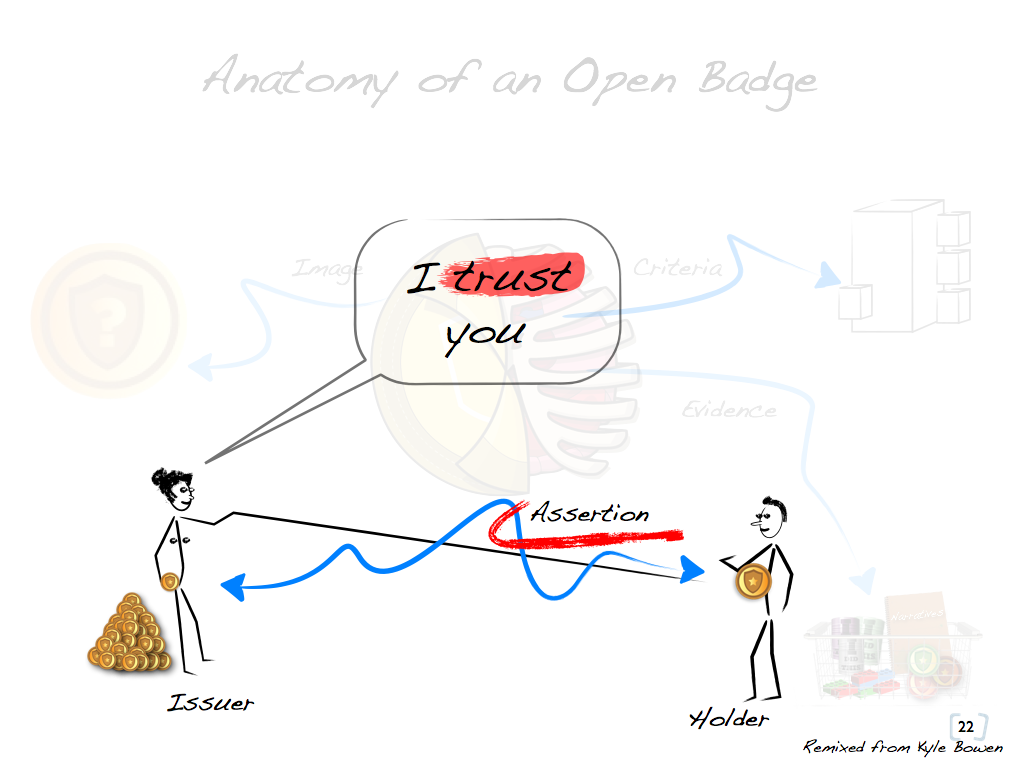
One of my (many) interests in Open Badges is in relation to trust. Oblivious to Open Badges imagesI can’t help but see Open Badges as primarily a trust relationships between Open Badge issuers and Open Badge holders, or recipients. Trust is expressed through an assertion which is informed by a series of criteria and evidence, eventually represented by a pretty picture. The current implementation of Open Badges does not (yet) fully exploit the potential of  trust relationships: as the chain of trust is fragmented  (we cannot establish that A trusts B who trusts C who trusts…). Far from being learner centered, i.e. badge holder centered, the Open Badge Infrastructure (OBI) is badge issuer centered. What connects badges together are the badge issuers (one issuer can trust many recipients). The user-centeredness of Open Badges rests in the discourses and not (yet) in the technological infrastructure. OBI is asymmetrical, and the asymmetry, if not corrected, will ultimately profit the institutions, not the individuals, and favour the concentration of Open Badges services, like Credly, into the hands of a limited number of providers.

Continue reading

Punished by Open Badges?

Punished by Rewards Book CoverWhy Open Badges Could Either Kill or Cure Learning?
As many Open Badges supporters, and self-appointed ambassadors, I had absolutely no reservation regarding Open Badges: I saw them as the natural development of the work I did on ePortfolios as a means to support, recognise and celebrate learning and achievements: I envisioned Open Badges as a means to create an open and distributed ePortfolio architecture.

I saw no evil in Open Badges. That is, until I learned about Punished by Rewards: The Trouble with Gold Stars, Incentive Plans, A’s, Praise, and Other Bribes. As the book was written by Alfie Kohn in 1993, and revised in 1999, it does not address Open Badges. Yet, the book provides plenty of evidence from research eliciting the deleterious effects of extrinsic motivation on learning (and work), one of the most noxious legacies of B.F. Skinner, the psychologist described by Alfie Kohn as the one who “experimented with pigeons and wrote on people.”

This post is divided into 3 main parts:

  1. An exploration on the potential dangers of Open Badges practice (Open Badges as glorified gold stars) and infrastructure (asymmetry)
  2. An exploration of the potential benefits of Open Badges practice (Open Badges as distributed ePortfolios) and infrastructure (trust).
  3. What needs to be done ASAP[1] to minimise the risks and maximise the potential of Open Badges

One of the objectives of this post is to prepare the welcome of Alfie Kohn as keynote speaker at ePIC 2014. Shall Open Badges and ePortfolios pass the Alfie Kohn test? Whatever the results, his presence should contribute to raising key questions and possibly debunk some of the prejudices hidden in our practices.

In the Reference section of this post you will find some of the (very few) posts addressing the same issue as well as references to Alfie Kohn’s writings and public speaking.

Why Open Badges Could Kill the Desire to Learn?

Continue reading

User Generated Contexts are COOLE!

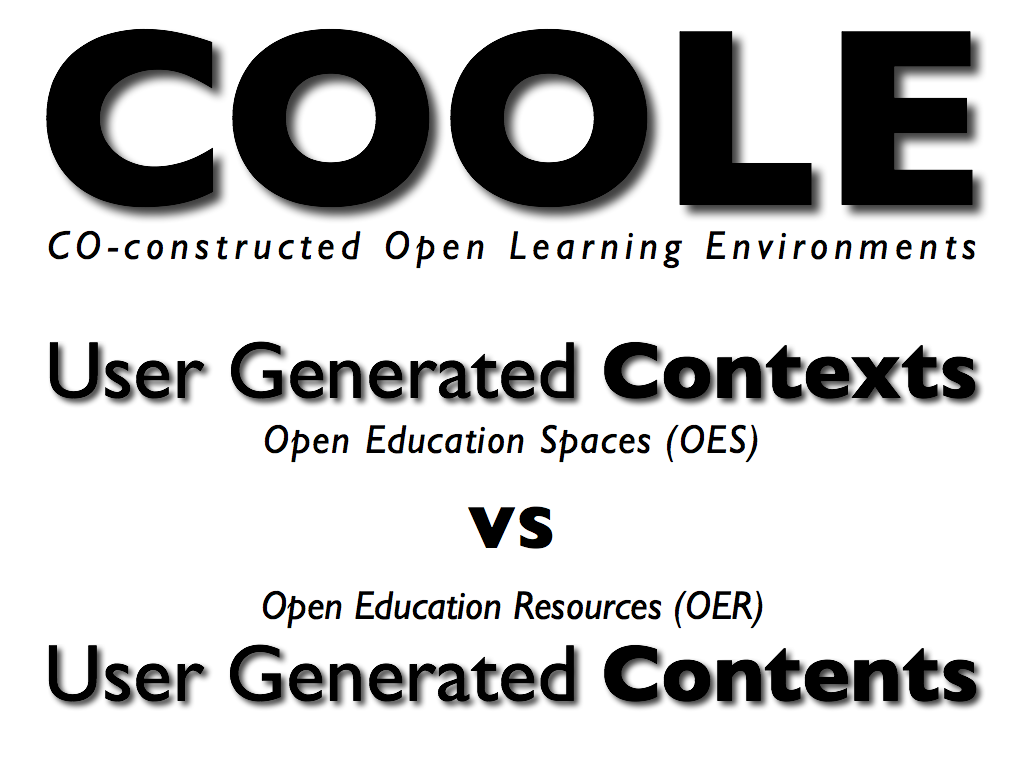
We need to address the current asymmetry in the type of technologies developed for education: we have many teaching technologies (LMS, electronic whiteboards, OER, etc.) and substantially less authentic learning technologies. Evidence of this asymmetry, amongst others, is to be found in the fragmentation of the learning landscape and infrastructure, something obvious when a pupil moves from one school to another or when studying at different institutions. How can we put an end to this fragmentation? How can we create a truly Open Education Space (OES)? By making learners the designers, builders and operators of their learning environments, the authors of their learning contexts!

While, thanks to the rise of knowledge media, we now have many practices based on / leading to user generated contents, what we now need are technologies and practices leading to user generated contexts. Why not build digital learning environments based on the MineCraft paradigm, i.e. using a technology accessible to everybody? Why should Moodle and the like be left in the hands of the teaching high priests? The issue is not just to make Moodle more ‘open’ or to give students authoring accounts (to mimic what their teachers do?) but to create new tools, with which they would be empowered to design their own learning environments.

Make learners the architects of their co-constructed learning environment(s)! This is a very different view from the individualistic PLE, or the course-focused MOOC (prefixed with either a ‘c’ or an ‘x’). A User Generated Context should be more like a co-designed / co-constructed / co-operated open learning environment,  a self-generated learning context — autopoiesis.

I will christen this new object: COOLE (CO-constructed Open Learning Environment). Probably what we need for the development of an Open Education Space (OES), beyond institutional boundaries.

UGC

How to make learning COOLE?

Continue reading

Recognition and Accreditation of Competencies in 2030: How Different?

Wednesday 16 October 2013, I was invited to give a keynote address at a conference[1] in Warsaw celebrating the publication of 300 competency standards[2] at the initiative of the Department of Labour Market from the Polish Ministry of Labour and Social Affairs. Participants included the State Secretary from the Ministry of Labour and Social Affairs, representatives of social partners such as the Polish Craft Association, the Polish Chamber of Commerce, different employer associations and trade unions.

It was interesting to witness how much has been achieved 6 years after the publication of 200 qualification standards and my first visit to Warsaw when on the 18 December 2007 I was invited to give a keynote at a conference entitled National Occupational Standards as a Tool for Employment and Education Policy. The brief for this year’s keynote was to invite the participants to explore the potential of those newly published competency standards to support, recognise and accredit learning.

What follows is the abstract of my presentation[3].

Continue reading

Open Badges to the World

An Open Badge describes a criteria– and evidence-based trust relationship between an issuer and a recipient. Criteria, evidence, issuer and recipient are represented as a set of metadata ‘baked’ into a picture, the actual visual representation of an Open Badge. What I would like to explore is how metadata could connect Open Badges to the rest of the world by making criteria easily accessible, shareable and reusable by applications and services beyond the realm of Open Badges. I will focus more precisely on badges awarded for the acquisition of competencies.

When a badge is delivered in recognition of the acquisition of a new competency or a series of competencies, the badge issuer provides the information relative to the awarding criteria via a URL. The URL points to the definition of the criteria.

Some of the questions that (should) come to mind when designing a new badge are:

  • are there existing criteria or definitions that could be used to issue this new badge? Has someone already delivered a similar badge? Is there an existing competency framework to refer to?
  • where should those definitions be stored? On the original issuer server? On a public space?
  • who else might be interested in using those definitions beyond the delivery and exploitation of Open Badges?

Today, competency frameworks are used for many different purposes:

  • designing a job description
  • hiring employees
  • finding project partners
  • planning continuing professional development
  • tagging portfolio evidence
  • tagging learning resources
  • reviewing annual performance
  • accrediting  prior learning
  • awarding a badge
  • and much more…

For example, when someone compiles a portfolio for accreditation of prior learning that will lead to the awarding of a badge, the same criteria will be used to tag evidence, narratives, xAPI statements (experience API) and Open Badges. Continue reading

Tagging with URI

Cross-referencing is one of the key activities when building a portfolio used for accreditation of prior learning or to gain a competency-based qualification. How does it work:

  • On the one hand, candidates have a list of competencies and performance criteria
  • On the other hand, candidates collect a number of evidence demonstrating their competencies
Then
  •  for every piece of evidence the candidate indicates which competencies / units / elements / performance criteria it covers
  • for each unit / element / performance criteria the candidate indicates which pieces of evidence support the claim
With a computer, there is a very simple way of doing this: using competency definitions as tags. Once all the pieces of evidences are tagged with the various competency definitions it is easy to retrieve all those linked to a particular competency and the all the competencies linked to a single piece of evidence. The simple process of tagging creates all the cross references needed to have the portfolio reviewed by an assessor who can then (in)validate the links.
There are two ways of creating this kind of tag with existing systems:
  1. strings: the title of the competency/performance criteria —pros: relatively user friendly (probably not if the user has to key in long definitions); cons: ambiguity as the same string of characters can refer to different definitions; and risks of typos (that can be reduced by providing drop-down boxes)
  2. URL/URI: the address of the competency definition —pro: uniqueness; cons: not user friendly
There is a third way, that would require very little effort from ePortfolio publishers: using URL/URIs as tags while making it user-friendly: users would select a definition from a competency repository, drag it in the ‘tag’ section of the piece of evidence. The tag would appear as a string to the user, but the URI would point to the competency definition. The level of granularity of a URI could be down to a single performance criterion.
Ta make it backward compatible and allow users to create tags without URIs, the URI field could be set to null. This could also encourage groups of people and communities to create and share their own meaningful URIs/definitions.
Of course, this method of URI tagging is not restricted to ePortfolios and could be generalised to any kind of tagging, like linking a blog entry to Learning Forum London or ePortfolio 2009 could use the same URI http://www.epforum.eu —today it is ep2009, hoping that nobody else with use it or won’t use ePortfolio2009 or ePortfolio 09…
And of course, to make this work seamlessly, instead of having each ePortfolio system create its own internal representation of competency frameworks, these frameworks could be made public through a series of distributed repositories providing the desired URIs that could be shared within a community of professionals an organisation or a sector.
The solution to unique resource identifiers for competency definition has already been discussed by Simon Grant (Representing frameworks of skill and competence for interoperability and more recently in Representing defining and using ability competency and similar concepts). It is clear that we have all the technology required and the solutions are not exactly rocket science. What is missing is the political impetus and committment.
One could imagine that each URI is translated into a URL where the competency map could be represented by a hierarchy of directories:
  • language / sector / domain / area / unit / element / performance criteria
  • language / sector / domain / area / unit ? data = “knowledge”, “evidence examples”, etc.
This is one possible representation, and there are alternative equivalents.
One of the goals of EIfEL for the Learning Forum London conference is to create a consensus within the ePortfolio community, and possibly beyond, on:
  • “URI tagging” as a general mechanism for tagging
  • Establish a number of initial competency repositories providing URIs using existing occupational competency standards and a simple mechanism for growing internally and externally those repositories
  • Draw a roadmap for future developments

Learning 2.0 : User Generated Contents or User Generated Contexts ?

During a workshop organised to review a study on Learning 2.0 at IPTS in Seville, in order to express my vision of what Learning 2.0 might be about, I proposed to reflect on the concept of User Generated Context.

There are currently many discussions and initiatives relative to User Generated Contents, and this is often presented as one of the great achievements of Web 2.0. My position is that, while this is a good thing, this is not revolutionary: when I was a student, many of the polycopiés (printed course notes) were produced by students, often reviewed and validated by professors. And the Web 1.0 was very good at supporting and generalising this kind of practice. What has now changed, with technologies like wikis, is that it is easier to create course material collaboratively, keep it updated, connect it to many other kinds of resources and documents. For example, it is easy to cross-reference the portfolios of students who have worked on the contents of a particular course with the contents of the course itself, making the course material a kind of ‘learning magnet’ (rather than a ‘learning object’, but his is for another conversation), an attractor, an aggregator of ongoing intellectual production. The learning material becomes the result of a percolation process where the best of individual and collaborative production is being identified, recognised and celebrated.

I see what is happening with User Generated Contents, the ability to create, co-create, cross-reference knowledge as a first order learning. And moving from a system where learners as seen as mere consumers of contents, to a world where they are valued and celebrated as knowledge producers is certainly a worthwhile mental step. What I’m really interested in to explore is a second order of learning, where learners are not only the creators of contents but contexts, where learning outcomes are not simply contents but contexts, where the learning situation is flexible enough to be transformed in the very process of learning, where reflexive learning transforms learning—learning about learning.
EIfEL defines learning as the combination of individual, community, organisational, territorial and societal learning, which means that it is a transformative process which happens simultaneously within all these dimensions, each with their own rhythms of transformation. The context in which learning happens is not an invariant — group, institution, community etc. — but the outcome of previous learning and the starting point for further learning. But while we have some understanding of what a learning individual or organisation is, they are generally discussed in different communities, and rare are the teachers or parents that (want to) see the school as a learning organisation.

Moreover, the learning situation itself is a learning situation. While this sounds like a tautology, what I want to express is the idea that learning about learning, reflective learning transforms learning. The learning context is changed by the learning itself. This is not as elegant and striking as James Glieck writing “Life learned itself into existence”, who conveys the idea that learning and life are the two sides of the same object, but this is the same kind of idea that I would like to elicit by what will sound like a double tautology: “learning learned itself into learning”.

By moving the reflection from contents to contexts, we might have an opportunity to better connect individual and organisational learning, creating the conditions for institutional transformation, inviting pupils and parents to invent the school of tomorrow.

This also has an implication on the way we use technology, how learning environments are being constructed. The experience of pupils and students moving from the technology they use in ‘real life’ to the one used by institutions is often extremely frustrating as institutions are generally incapable of (or don’t want) providing state of the art technology — many school and university digital learning environments are wonderful time travel machine… to the past (in terms of technologies as well as pedagogies).

Why not use pupils and students to create the contexts in which they learn, using state of the art technology, inventing tomorrows technologies and practices. What we have today with digital technology such as social computing, virtual worlds, ePortfolios (individual and organisational) is the ability to create our own contexts and transform the contexts in which we operate. The context itself can become the artefact produced as outcome of a learning process. It should.

Of course, the very idea of User Generated Contexts renders obsolete the programme assigned to Learning Design (in the sense of IMS-LD and other Educational Modelling Languages – EML), unless EML had the ability to transform itself through some kind of auto-coding, while learning takes place. IMS-Learning Design being incapable of supporting such vision, it might be time to send it once for all to the dustbin of technology history.