ePortfolios & Open Badges at the Service of Learning eQuality

Monday January 13th, I was invited to present how Open Badges and ePortfolios could contribute to the quality of learning at a seminar on quality in distance education organised by the FIED (Fédération Interuniversitaire de l’Education à Distance).

I took the opportunity develop further a reflection started  in 2007 with the publication of a green paper entitled From quality of eLearning to eQuality of learning (link). The objective was to explore an alternative path to the mechanistic, and too often trivial, approaches to quality and eLearning.

Quality as Learning

One of the questions raised in the green paper was:

What would the consequences be if we moved our reflection from quality of learning, to quality as learning?

In response, the green paper proposed:

to shift the focus from quality of eLearning to eQuality as learning, i.e. reflect on how digital technologies can provide support for improving all forms of learning – instruction and training, face to face, at a distance, or mixed, formal and informal, personal and organisational – making the quality process itself a personal and organisational experience.


ePortfolios & Open Badges to the Service of Learning Quality from Serge Ravet
(The presentation accessible on Slideshare has no sound, but the original presentation was recorded and will be soon available, in French)

Continue reading

Punished by Open Badges?

Punished by Rewards Book CoverWhy Open Badges Could Either Kill or Cure Learning?

As many Open Badges supporters, and self-appointed ambassadors, I had absolutely no reservation regarding Open Badges: I saw them as the natural development of the work I did on ePortfolios as a means to support, recognise and celebrate learning and achievements: I envisioned Open Badges as a means to create an open and distributed ePortfolio architecture.

I saw no evil in Open Badges. That is, until I learned about Punished by Rewards: The Trouble with Gold Stars, Incentive Plans, A’s, Praise, and Other Bribes. As the book was written by Alfie Kohn in 1993, and revised in 1999, it does not address Open Badges. Yet, the book provides plenty of evidence from research eliciting the deleterious effects of extrinsic motivation on learning (and work), one of the most noxious legacies of B.F. Skinner, the psychologist described by Alfie Kohn as the one who “experimented with pigeons and wrote on people.”

This post is divided into 3 main parts:

  1. An exploration on the potential dangers of Open Badges practice (Open Badges as glorified gold stars) and infrastructure (asymmetry)
  2. An exploration of the potential benefits of Open Badges practice (Open Badges as distributed ePortfolios) and infrastructure (trust).
  3. What needs to be done ASAP[1] to minimise the risks and maximise the potential of Open Badges

One of the objectives of this post is to prepare the welcome of Alfie Kohn as keynote speaker at ePIC 2014. Shall Open Badges and ePortfolios pass the Alfie Kohn test? Whatever the results, his presence should contribute to raising key questions and possibly debunk some of the prejudices hidden in our practices.

In the Reference section of this post you will find some of the (very few) posts addressing the same issue as well as references to Alfie Kohn’s writings and public speaking.

Why Open Badges Could Kill the Desire to Learn?

Continue reading

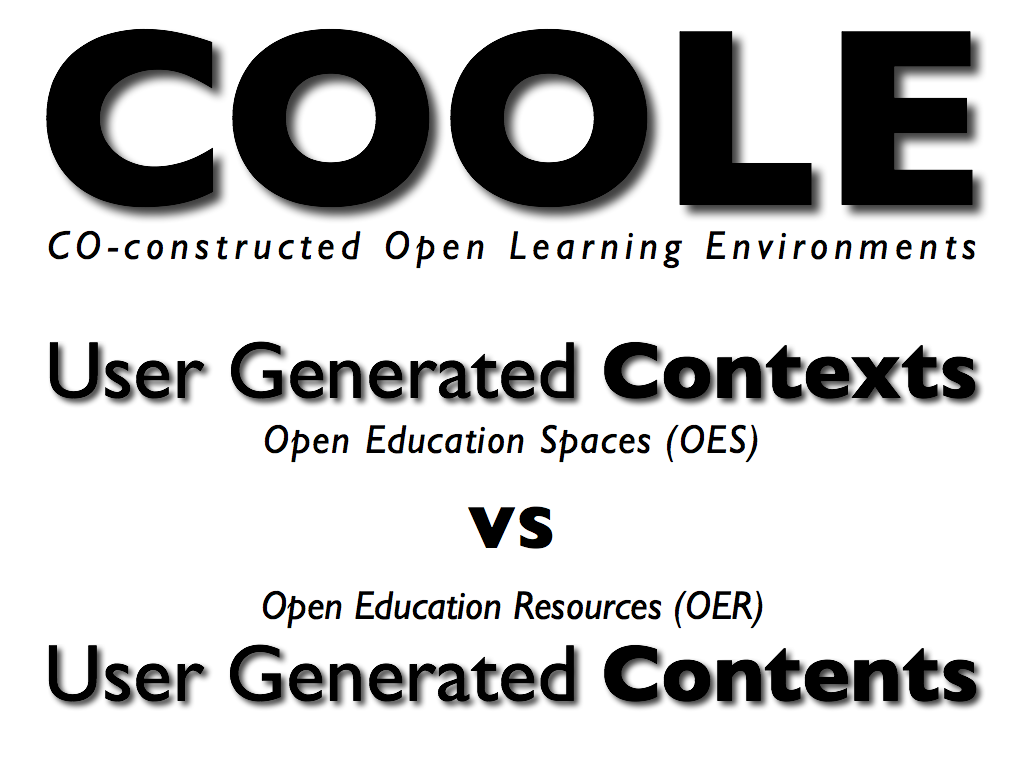
User Generated Contexts are COOLE!

We need to address the current asymmetry in the type of technologies developed for education: we have many teaching technologies (LMS, electronic whiteboards, OER, etc.) and substantially less authentic learning technologies. Evidence of this asymmetry, amongst others, is to be found in the fragmentation of the learning landscape and infrastructure, something obvious when a pupil moves from one school to another or when studying at different institutions. How can we put an end to this fragmentation? How can we create a truly Open Education Space (OES)? By making learners the designers, builders and operators of their learning environments, the authors of their learning contexts!

While, thanks to the rise of knowledge media, we now have many practices based on / leading to user generated contents, what we now need are technologies and practices leading to user generated contexts. Why not build digital learning environments based on the MineCraft paradigm, i.e. using a technology accessible to everybody? Why should Moodle and the like be left in the hands of the teaching high priests? The issue is not just to make Moodle more ‘open’ or to give students authoring accounts (to mimic what their teachers do?) but to create new tools, with which they would be empowered to design their own learning environments.

Make learners the architects of their co-constructed learning environment(s)! This is a very different view from the individualistic PLE, or the course-focused MOOC (prefixed with either a ‘c’ or an ‘x’). A User Generated Context should be more like a co-designed / co-constructed / co-operated open learning environment,  a self-generated learning context — autopoiesis.

I will christen this new object: COOLE (CO-constructed Open Learning Environment). Probably what we need for the development of an Open Education Space (OES), beyond institutional boundaries.

UGC

How to make learning COOLE?

Continue reading

Recognition and Accreditation of Competencies in 2030: How Different?

Wednesday 16 October 2013, I was invited to give a keynote address at a conference[1] in Warsaw celebrating the publication of 300 competency standards[2] at the initiative of the Department of Labour Market from the Polish Ministry of Labour and Social Affairs. Participants included the State Secretary from the Ministry of Labour and Social Affairs, representatives of social partners such as the Polish Craft Association, the Polish Chamber of Commerce, different employer associations and trade unions.

It was interesting to witness how much has been achieved 6 years after the publication of 200 qualification standards and my first visit to Warsaw when on the 18 December 2007 I was invited to give a keynote at a conference entitled National Occupational Standards as a Tool for Employment and Education Policy. The brief for this year’s keynote was to invite the participants to explore the potential of those newly published competency standards to support, recognise and accredit learning.

What follows is the abstract of my presentation[3].

Continue reading

Open Badges to the World

An Open Badge describes a criteria– and evidence-based trust relationship between an issuer and a recipient. Criteria, evidence, issuer and recipient are represented as a set of metadata ‘baked’ into a picture, the actual visual representation of an Open Badge. What I would like to explore is how metadata could connect Open Badges to the rest of the world by making criteria easily accessible, shareable and reusable by applications and services beyond the realm of Open Badges. I will focus more precisely on badges awarded for the acquisition of competencies.

When a badge is delivered in recognition of the acquisition of a new competency or a series of competencies, the badge issuer provides the information relative to the awarding criteria via a URL. The URL points to the definition of the criteria.

Some of the questions that (should) come to mind when designing a new badge are:

  • are there existing criteria or definitions that could be used to issue this new badge? Has someone already delivered a similar badge? Is there an existing competency framework to refer to?
  • where should those definitions be stored? On the original issuer server? On a public space?
  • who else might be interested in using those definitions beyond the delivery and exploitation of Open Badges?

Today, competency frameworks are used for many different purposes:

  • designing a job description
  • hiring employees
  • finding project partners
  • planning continuing professional development
  • tagging portfolio evidence
  • tagging learning resources
  • reviewing annual performance
  • accrediting  prior learning
  • awarding a badge
  • and much more…

For example, when someone compiles a portfolio for accreditation of prior learning that will lead to the awarding of a badge, the same criteria will be used to tag evidence, narratives, xAPI statements (experience API) and Open Badges. Continue reading

My ePortfolio, our Badge!

[The first idea for a title was: User-Driven Badges vs User-Driven ePortfolios.]

Yesterday, during the Open Badges weekly meeting (link), Patrick McGee (1) from The Volunteer Centre Blackpool, Wyre and Fylde’s  presented Do A Bit, a project using Mozilla Open Badges, in conjunction with a volunteer passport, to increase participation in volunteering and to reward participants (2).

One particular element of the strategy stroke my attention: volunteers are invited to tell what skills they would like to be recognised with an Open Badge. It is not the organisation that is deciding what are the badges worth delivering, but the participants deciding on which badges they would like to have designed, just for them.

Although this is very much in line with a presentation I attended some time ago where teachers were inviting students to establish together their badges awarding criteria [I need to add a reference!], this made me ask the following question: could something like that have happened with ePortfolios? After all, aren’t ePortfolios, like Open Badges,  designed for making learning visible to others and oneself – reflective learning? At that point of my reflection, the answer is… probably not…

This post is a first attempt at explaining why, although ePortfolios and Open Badges are supposed to be user-centric, Open Badges have a greater potential to be user-driven, than ePortfolios.

My ePortfolio, our Badge

One of the main differences I see between ePortfolios and Open Badges is the social dimension. Collective ePortfolios remain a rarity, a good theme for an inspirational keynote address at a conference! Yet, when reflecting on the dialectic between individual and collective ePortfolios, one can ask whether:

  •  a collective ePortfolio is an aggregation of individual ePortfolios, or
  •  the individual ePortfolio is a projection, on the individual plan, of a collective ePortfolio?

There is probably no such thing as a personal narrative that is not deeply intertwined with other people’s narratives. The interweaving of our stories are like the threads of a social fabric. Yet the technologies developed for ePortfolios lead to the creation of personal silos of information where the natural interweaving of our narratives is fragmented. We have lost the opportunity of presenting the threads of our narratives in the context of a rich, dense and colourful fabric (a possible variation of T. S. Eliot’s Where is the knowledge we have lost in information?). And from that point of view, there is certainly no advantage in using an ePortfolio platform over a simple blog system — ePortfolio platforms remain still useful for institutions (that are mostly silos!).

Continue reading

Open Badges are more than Pretty Pictures

One of the reasons why Open Badges are so popular is their ability to make visible what people have achieved. And the way to make the achievements visible is through the display of a picture. Several times in the past I have commented that Open Badges are more than pretty pictures and that there is a risk that the  pretty pictures might become to the Open Badge Infrastructure (OBI) what the proverbial tree is to the forest…

What gives value to the pretty picture is the metadata baked into it, i.e. the links to the issuer, the recipient, the awarding criteria and possibly the evidence informing the criteria. Without metadata (and the underpinning OBI trust architecture) a badge would be dumb. Conversely, a badge does not really need a picture to be made visible: from the point of view of accessibility, or simply good design, any picture should have an “alt” field properly informed, so a visually impaired reader could make sense of it. It should be the choice of the badge owner or reader to decide whether to see the picture or the textual version. This would be practical to compose a CV from a collection of badges without having to force a potential employer or client to figure out what those pretty pictures mean.

Why should the pretty pictures be dynamic?

There could be various reasons why the picture displayed by a badge should be dynamic, depending on the point of view:

  1. Issuer: an issuer can decide that a badge is valid for a certain period of time, after which the candidate needs to become re-accredited. Being able to provide a visual cue on the badge, such as changing from bright colours to grey, from sharp to fuzzy, or displaying a countdown to the expiration date, are some of the many options an issuer should be able to choose from.
  2. Recipient: a candidate could pledge for a badge and display a pie-chart indicating the % of progress towards achievement. This would be a means to show potential employers or clients ones current learning, not just past achievements.
  3. Reader: an employer reads a series of CV’s with 100+ badges, many of them totally new to her/him (except for those delivered by well known brands of education providers) and wants to use her/his CSS to create a display relevant to her/his own needs based on the baked metadata.

 Why Should the Design of Pretty Pictures be Consistent?

Continue reading

Hello World!

Hello world! is a message well known to the apprentice programmer and webmaster: it is the typical output one tries to get when learning a new programming language or checking whether a system is operating correctly.

Such is the case: after many years of (extremely) irregular postings to my blog, I have installed an instance of WordPress and configured it in such a way that all my posting will go seamlessly to my different Twitter and Facebook accounts. This message is a means to test whether I have done a good job when configuring WordPress!

Hello world! is also meant to convey another, less technical, message: I have made the decision to keep a regular journal on learning technologies and identities. Why do I believe that the frequency of my postings will be less stochastic than in the past? Open Badges is the answer!

Open Badges is a truly open community, where every contribution, from the most humble to the most challenging, is welcomed, nurtured and reviewed with consideration by a community supported by the Mozilla Foundation. Being part of the Open Badges community gives one the sense of contributing to a global co-design exercise. Thousands of initial practitioners have delivered hundreds of thousands of badges, and their experience is directly fed-back into the design circuit. Open Badges is truly a learning technology, in the sense that the technology is the result of a learning process, a community learning process.

This is a very different experience from the one I had within the ePortfolio community. For example, when in 2010 I wrote the 10 ePortfolio challenges, the text generated some polite interest but no actual commitment. Conversely, after I wrote Open Badges vs Tin Can, within a few weeks two communities that had never worked together before (ADL/SCORM and Open Badges) joined their efforts to write a series of use cases and are now working on the specifications for a demonstrator.

Continue reading

To create a trustworthy Internet respectful of privacy, shouldn’t we simply make our personal data public?

In the developments relative to trust and privacy technologies, one of the goals was to provide people with the means to protect their personal data: personal data is mine! This has naturally led to the idea of personal lockers and personal data stores: if all of my data is in my personal locker, then I can decide who has access to it and under which conditions (for how long, to do what, etc.). Personal Data Stores rapidly became the Holy Grail for the most advanced actors in the field of personal data management, from ePortfolios to personal health records. Personal lockers and personal data stores helped us to understand that an Internet based on a clear separation between storage of personal data and services creating/exploiting them would revolutionise the Internet. Empowered users would be at the centre of an ecosystem they control. “The Semantic Web & THE POWER OF PULL”, by David Siegel admirably describes the transformations one should expect from the systematic use of personal lockers.
However radical and transformative, personal lockers and personal data stores have their limits. One is to be found in the initial statement: personal data is mine! Data, the product of social interaction and processes, is generally shared with other people and organisations: I share the name of my parents, the review of a paper submitted with reviewers and conference organisers, the diagnosis of my illness with a doctor, a laboratory and a drugstore. Even my intimate thoughts can be shared when I commit a freudian slip… If most data is shared with others then we might want to rewrite the initial statement with: personal data is ours! Translation into technology of this statement might lead to something radically different from personal data stores as personal information silos.
Wouldn’t it be wonderful if we were able to exploit the natural property of data as a connection to people (places, ideas etc.) while preserving the need for privacy, anonymity and enabling trust? Could Shared Data Stores or Shared Lockers be a solution?
Another problem with personal data lockers is in the name itself. If they are personal, that means that they contain information that renders their owners identifiable. If they are lockers it means that there will always be someone ready to break in to steal data —who would be stupid enough to break into a safe if money grew on trees in public parks? And is there not a contradiction between aiming at the creation of a trust environment while basing it on highly protected safes and lockers? In an environment I trust, I’m not afraid to leave my wallet on the table… So, if personal lockers are not that safe, does it mean that the alternative is between abandoning the idea of privacy altogether and developing technologies that would create higher and thicker walls around our personal lockers? Is there an escape from an alternative that can only lead to an escalation in the development of distrust technologies?
Starting from the premises above, can we design an architecture that is at the same time natively social (data is ours!) and natively anonymous (I share my data but you can’t connect this data with the real me)? Anonymity is extremely hard to implement, it is why it should be a native feature and not an add-on, like anonymisation or encryption are.
Imagine that, instead of storing our data in personal lockers, we store them in Public Anonymous Data Stores (PADS). When I store a piece of data in a PADS, anonymously, I receive in exchange a key that allows me to edit it. Associated to this data is a kind of mailbox, so if someone wants to contact me, it is possible to leave a message in the box. My data can be distributed over a number of PADS and I’m the only one to know that it is my data. For the rest of the world, my data is just a drop in an ocean of anonymous data.
Putting personal data in PADS allows fine search granularity while respecting anonymity. Let’s say that someone is looking for a professional in the region of Chablis (not far from where I live) who has some expertise in ePortfolios. The enquirer leaves a message in the PADS mailboxes of all the people who have declared living in Chablis and in all those who have declared an ePortfolio expertise. When people collect their mailboxes from their PADS, only those that match both criteria are notified*. The person who has made the query doesn’t know whether there is someone matching the query until the target(s) decides to notify him/her that there is a match; and even then the target(s) remains fully anonymous.
Of course, when we make a query we expect to have timely, if not instant, feedback. As it is very unlikely that people will collect their mail at the same time and even less likely that they will want to spend any time validating more of less relevant queries. We need something more, something able to take decisions on our behalf. A software agent or proxy could do the trick, so that when someone queries the Internet, it is the agents that act on our behalf that validate, or not, visibility of the match. PADS + agents/proxies give us the power to control our visibility on the Internet.
Going back a few years, we advocated that every citizen should have an ePortfolio, then that every citizen should have a personal data store, we now would like to explore how to provide every citizen with a personal agent or proxy operating, on our behalf, in a space where our personal data is stored in PADS to explore the question:
To create a trustworthy Internet respectful of privacy, shouldn’t we simply make our personal data public?
It is one of the discussions that will be in the background of the 9th international ePortfolio and Identity Conference. You are welcome to contribute to it.

10 ePortfolio challenges

For the 7th ePortfolio conference, and in order to give directions to our work towards our 2010 goal (ePortfolio for all), EIfEL decided to address a number of challenges to the ePortfolio community and beyond —many of the problems the ePortfolio community faces today will not be resolved if they are not addressed beyond the ePortfolio silo. The goal of these challenges is to move beyond the current state of ePortfolio development, in particular in the field of interoperability as interoperability is not just a technical issue, but a means to enable new practices and the emergence of truly lifelong and life wide ePortfolios.

The ten challenges are:
  1. Universal ePortfolio Repository —a unified view of all my assets
  2. Universal Competency Identifiers —share competency definitions across systems
  3. ePortfolio social —share assets, knowledge and processes across communities
  4. ePortfolio semantic editors —make sense of what I write, connect, etc.
  5. ePortfolio Readers —read any ePortfolio through consistent and multiple views
  6. Open & Trusted Service Architecture
  7. ePortfolio based performance support system —make the ePortfolio part of my work
  8. ePortfolio discovery mechanism —find people, competencies, resources
  9. URIs as tags —make tags meaningful
  10. Universal Metadata —create a world brain

Our main objective is to create the conditions for the emergence of MultiPortfolio organisations (one organisation can interact with many different ePortfolio platforms) and MultiOrganisation ePortfolios (have one ePortfolio to interact with many different institutions with their own platform).

Challenges’ link

Other documents related to the challenges are: