#OpenBadges for Key Competencies

This post is an extract of a position paper, Key Competency Badges, a reflection based on the work done in the TRANSIt project in relation to the acquisition of key competencies.

How to combine Open Badges with key competencies? To what result? One way to approach this question is to recognise that key competencies are just one particular group of competencies, so what is good for the recognition of competencies in general, is likely to be just as good for key competencies. As there are already plenty of Open Badges used to recognise a large range of competencies, then it is just a matter of extending current practice.

What is implied with this approach is that Key Competency Open Badges will need key competency standards similar to the UK key skill 2000 introduced above. While it might seem unproblematic to define standards related to the mastery of mathematics and foreign languages, things might get more complicated with digital competencies and even more with the sense of initiative and entrepreneurship and social and civic competencies. For example, the French authorities decided to remove ‘entrepreneurship’ from the European key competency labelled “sense of initiative and entrepreneurship.” The French version is “autonomie et initiative” [5] (autonomy and initiative).

Continue reading

From ePortfolio to Open Badges – on the Individuation of Technical Objects

Introduction

In 2004, during the second international ePortfolio conference (La Rochelle, France) a group of participants agreed to launch a campaign on the theme ePortfolio for all! Their objective was “by 2010, every citizen will have an ePortfolio!” 10 years later, despite a growing number of ePortfolio initiatives worldwide, we are still very far from achieving this goal.

This text is an attempt at exploring why the global adoption of Open Badges is likely to succeed and how it might feedback into ePortfolio technologies and practices. For that purpose, in the perspective of the genesis of technological objects, I draw a parallel with the evolution of computer technology from the early generation of computers to the advent of integrated circuits and computer chips (CPU, central processing units). The emergence of Open Badges will be analysed as a result of the evolution of ePortfolios, their concrétisation (reification). ePortfolios are more abstract, Open badges more concrete as the result of an individuation process.

While the genesis of technological objects and the process of individuation has been described with talent by philosophers like Gilbert Simondon and Bernard Stiegler, this post simply aims at inviting the members of the ePortfolio community to reflect on their practices and the possible futures for ePortfolio technologies.

On the Mode of Existence of Technical Objects

In Du mode d’existence des objets techniques (On the Mode of Existence of Technical Objects, 1958) Gilbert Simondon describes the concrétisation of technical objects as the ability of objects to become more autonomous, self-regulated, in relation to the associated milieu in which they operate. This process has a corollary, abstraction, which is when an object becomes more dependent on its associated milieu, as is the case with a number of genetically modified organisms — e.g. induced sterility in order to control the crop market, regulations, etc.

Continue reading

Open Badges Unite! Connecting Open Badges through Evidence

Open Badges as Trust Relationship

Open Badges as Trust Relationship

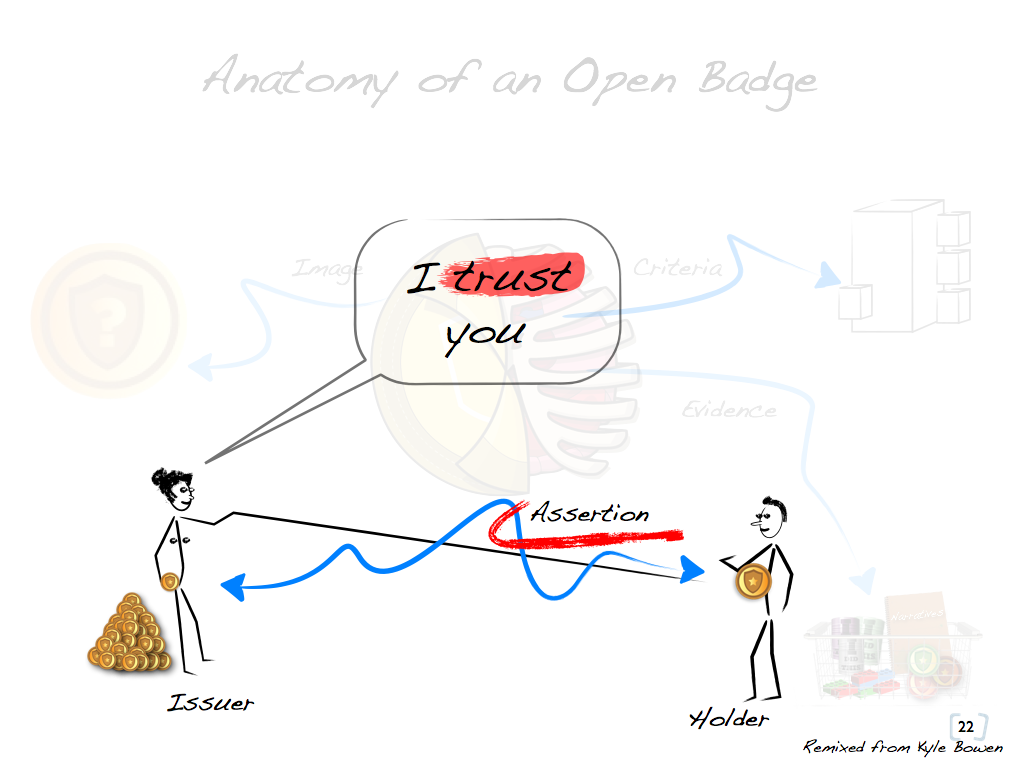
One of my (many) interests in Open Badges is in relation to trust. Oblivious to Open Badges imagesI can’t help but see Open Badges as primarily a trust relationships between Open Badge issuers and Open Badge holders, or recipients. Trust is expressed through an assertion which is informed by a series of criteria and evidence, eventually represented by a pretty picture. The current implementation of Open Badges does not (yet) fully exploit the potential of  trust relationships: as the chain of trust is fragmented  (we cannot establish that A trusts B who trusts C who trusts…). Far from being learner centered, i.e. badge holder centered, the Open Badge Infrastructure (OBI) is badge issuer centered. What connects badges together are the badge issuers (one issuer can trust many recipients). The user-centeredness of Open Badges rests in the discourses and not (yet) in the technological infrastructure. OBI is asymmetrical, and the asymmetry, if not corrected, will ultimately profit the institutions, not the individuals, and favour the concentration of Open Badges services, like Credly, into the hands of a limited number of providers.

Continue reading

Punished by Open Badges?

Punished by Rewards Book CoverWhy Open Badges Could Either Kill or Cure Learning?

As many Open Badges supporters, and self-appointed ambassadors, I had absolutely no reservation regarding Open Badges: I saw them as the natural development of the work I did on ePortfolios as a means to support, recognise and celebrate learning and achievements: I envisioned Open Badges as a means to create an open and distributed ePortfolio architecture.

I saw no evil in Open Badges. That is, until I learned about Punished by Rewards: The Trouble with Gold Stars, Incentive Plans, A’s, Praise, and Other Bribes. As the book was written by Alfie Kohn in 1993, and revised in 1999, it does not address Open Badges. Yet, the book provides plenty of evidence from research eliciting the deleterious effects of extrinsic motivation on learning (and work), one of the most noxious legacies of B.F. Skinner, the psychologist described by Alfie Kohn as the one who “experimented with pigeons and wrote on people.”

This post is divided into 3 main parts:

  1. An exploration on the potential dangers of Open Badges practice (Open Badges as glorified gold stars) and infrastructure (asymmetry)
  2. An exploration of the potential benefits of Open Badges practice (Open Badges as distributed ePortfolios) and infrastructure (trust).
  3. What needs to be done ASAP[1] to minimise the risks and maximise the potential of Open Badges

One of the objectives of this post is to prepare the welcome of Alfie Kohn as keynote speaker at ePIC 2014. Shall Open Badges and ePortfolios pass the Alfie Kohn test? Whatever the results, his presence should contribute to raising key questions and possibly debunk some of the prejudices hidden in our practices.

In the Reference section of this post you will find some of the (very few) posts addressing the same issue as well as references to Alfie Kohn’s writings and public speaking.

Why Open Badges Could Kill the Desire to Learn?

Continue reading

My ePortfolio, our Badge!

[The first idea for a title was: User-Driven Badges vs User-Driven ePortfolios.]

Yesterday, during the Open Badges weekly meeting (link), Patrick McGee (1) from The Volunteer Centre Blackpool, Wyre and Fylde’s  presented Do A Bit, a project using Mozilla Open Badges, in conjunction with a volunteer passport, to increase participation in volunteering and to reward participants (2).

One particular element of the strategy stroke my attention: volunteers are invited to tell what skills they would like to be recognised with an Open Badge. It is not the organisation that is deciding what are the badges worth delivering, but the participants deciding on which badges they would like to have designed, just for them.

Although this is very much in line with a presentation I attended some time ago where teachers were inviting students to establish together their badges awarding criteria [I need to add a reference!], this made me ask the following question: could something like that have happened with ePortfolios? After all, aren’t ePortfolios, like Open Badges,  designed for making learning visible to others and oneself – reflective learning? At that point of my reflection, the answer is… probably not…

This post is a first attempt at explaining why, although ePortfolios and Open Badges are supposed to be user-centric, Open Badges have a greater potential to be user-driven, than ePortfolios.

My ePortfolio, our Badge

One of the main differences I see between ePortfolios and Open Badges is the social dimension. Collective ePortfolios remain a rarity, a good theme for an inspirational keynote address at a conference! Yet, when reflecting on the dialectic between individual and collective ePortfolios, one can ask whether:

  •  a collective ePortfolio is an aggregation of individual ePortfolios, or
  •  the individual ePortfolio is a projection, on the individual plan, of a collective ePortfolio?

There is probably no such thing as a personal narrative that is not deeply intertwined with other people’s narratives. The interweaving of our stories are like the threads of a social fabric. Yet the technologies developed for ePortfolios lead to the creation of personal silos of information where the natural interweaving of our narratives is fragmented. We have lost the opportunity of presenting the threads of our narratives in the context of a rich, dense and colourful fabric (a possible variation of T. S. Eliot’s Where is the knowledge we have lost in information?). And from that point of view, there is certainly no advantage in using an ePortfolio platform over a simple blog system — ePortfolio platforms remain still useful for institutions (that are mostly silos!).

Continue reading

Open Badges are more than Pretty Pictures

One of the reasons why Open Badges are so popular is their ability to make visible what people have achieved. And the way to make the achievements visible is through the display of a picture. Several times in the past I have commented that Open Badges are more than pretty pictures and that there is a risk that the  pretty pictures might become to the Open Badge Infrastructure (OBI) what the proverbial tree is to the forest…

What gives value to the pretty picture is the metadata baked into it, i.e. the links to the issuer, the recipient, the awarding criteria and possibly the evidence informing the criteria. Without metadata (and the underpinning OBI trust architecture) a badge would be dumb. Conversely, a badge does not really need a picture to be made visible: from the point of view of accessibility, or simply good design, any picture should have an “alt” field properly informed, so a visually impaired reader could make sense of it. It should be the choice of the badge owner or reader to decide whether to see the picture or the textual version. This would be practical to compose a CV from a collection of badges without having to force a potential employer or client to figure out what those pretty pictures mean.

Why should the pretty pictures be dynamic?

There could be various reasons why the picture displayed by a badge should be dynamic, depending on the point of view:

  1. Issuer: an issuer can decide that a badge is valid for a certain period of time, after which the candidate needs to become re-accredited. Being able to provide a visual cue on the badge, such as changing from bright colours to grey, from sharp to fuzzy, or displaying a countdown to the expiration date, are some of the many options an issuer should be able to choose from.
  2. Recipient: a candidate could pledge for a badge and display a pie-chart indicating the % of progress towards achievement. This would be a means to show potential employers or clients ones current learning, not just past achievements.
  3. Reader: an employer reads a series of CV’s with 100+ badges, many of them totally new to her/him (except for those delivered by well known brands of education providers) and wants to use her/his CSS to create a display relevant to her/his own needs based on the baked metadata.

 Why Should the Design of Pretty Pictures be Consistent?

Continue reading

Hello World!

Hello world! is a message well known to the apprentice programmer and webmaster: it is the typical output one tries to get when learning a new programming language or checking whether a system is operating correctly.

Such is the case: after many years of (extremely) irregular postings to my blog, I have installed an instance of WordPress and configured it in such a way that all my posting will go seamlessly to my different Twitter and Facebook accounts. This message is a means to test whether I have done a good job when configuring WordPress!

Hello world! is also meant to convey another, less technical, message: I have made the decision to keep a regular journal on learning technologies and identities. Why do I believe that the frequency of my postings will be less stochastic than in the past? Open Badges is the answer!

Open Badges is a truly open community, where every contribution, from the most humble to the most challenging, is welcomed, nurtured and reviewed with consideration by a community supported by the Mozilla Foundation. Being part of the Open Badges community gives one the sense of contributing to a global co-design exercise. Thousands of initial practitioners have delivered hundreds of thousands of badges, and their experience is directly fed-back into the design circuit. Open Badges is truly a learning technology, in the sense that the technology is the result of a learning process, a community learning process.

This is a very different experience from the one I had within the ePortfolio community. For example, when in 2010 I wrote the 10 ePortfolio challenges, the text generated some polite interest but no actual commitment. Conversely, after I wrote Open Badges vs Tin Can, within a few weeks two communities that had never worked together before (ADL/SCORM and Open Badges) joined their efforts to write a series of use cases and are now working on the specifications for a demonstrator.

Continue reading

The Identity Centric Framework

The tremendous work done by organisations such as the Oasis Group, Liberty Alliance and Open ID on specifications and standards for digital identity call for a profound transformation of the Internet, moving from the “Internet of documents” to the “Internet of Subjects.” In an Internet of Subjects, we don’t want our actions to be limited by existing social network services provided by a third party, we want to be able to create social networks on the fly, just like in real life —and undo them without losing any data. We also want to be able to keep in one place (possibly distributed), a place we own, all the publications, contributions and various artefacts and tracks generated during our Internet activities.

Publication mechanisms like trackback demonstrate that it is possible to publish a blog entry or a comment in a personal space to make it visible in another one, so if a specific aggregation of blog entries/comments is not supported anymore (let’s say that this instance of Blogger disappears), then the entries and comments will still be available in my personal space (today I use a Word copy as save). Of course, the use of trackback has been impeded by pirates trying to circumvent anti-spam software, but this general mechanism (or equivalent) could be revived and systematised in a trustworthy environment, using social computing to support reputation mechanism.

In order to give a genral framework for these reflections, I’ve come up with something named the “Identity Centric Framework” (ICF) with the intention to to codify a set of fundamental principles to which any identity architecture should conform to be universal and sustainable. This framework can be seen as a derivation of the Microsoft’s identity metasystemand laws of identity. The principles can be summarised by the acronym “ID TOUCH.”

A universal identity centric system should be:

  • Independent: it should be sovereign and independent from commercial or partisan interests; it should be based on the existence of multiple, competitive, operators and technologies.
  • Dependable: it should have a provision to guarantee that personal data are free from potential loss or theft as well as identity attacks.
  • Transparent: it should provide accurate reports and statistics on how one’s personal data is being used by third parties. It should also provide negotiation and discovery mechanisms for social interaction and data exchange.
  • Opaque: it should provide mechanisms to fine-tune external visibility of personal data, up to the point of total opacity and anonymity —except for legal or regulatory requirements. It should include encryption and other techniques to limit the risks of undesired disclosure.
  • Unifying: it should provide a seamless experience across contexts (e.g. healthcare, education, employment, leisure, mobility) and identities while keeping a clear separation between independent contexts and multiple identities.
  • Communal: Identity systems must recognise and exploit the social nature of identity. Mechanisms such as reputation and trust should be native features of identity systems.
  • Humanist: the underpinning values of an identity centric system is a humanist vision of technology refusing the reification of human beings and promoting an open and free society.

From digital identity to socially connected free subjects

While the tools and architectures developed to support digital identity as a means of managing access to data (authorisation, authentication) and ensure that the policies attached to those data are being enforced (privacy, preventing identity theft), the general architecture of the Internet has not fundamentally changed. Federated identities (single sign on) and federated services (sharing identity attributes across domains) mark undoubtedly a progress for end-users as well as service providers. On the Internet, a space where there is no real face to face, it is now possible to establish a level of trust similar to that of the real world —including the possibility of being deceived or stolen… The translation in the cyberspace of real-life documents (identity cards) and practices (authorisation and authentication) could be described as the result of an assimilation process, a first order change.

Although, to a certain extent, we have been able to replicate in the cyberspace the documents and behaviours required for managing access to personal data —and a number of initiatives, like TAS3, are working on technologies that will increase the level of trust in transactions involving personal data— we are still far away from an Internet that could be qualified as Internet of subjects. Digital identity technology is only part of the solution that will fully empower individuals as active subjects of the Internet.

If we want to fully exploit the benefits of an ‘Internet of subjects’ based on the free association of self-conscious and self-controlled connected identities, a second order change is required. While this second order change will most likely build on the technical foundations led by consortia such as the Oasis Group, Liberty Alliance, OpenID and Open Social, the full power of these foundations need to be expressed within a new conceptual framework, a conceptual framework for digital subjects.